
For the pastry cream
Components
- One liter of full-fat milk
- Six egg yolks
- 1 cup (tea) of cornflour
- 1 1/4 cups of sugar (tea)
- 2 tablespoons of butter
- Half a vanilla bean (or 2 teaspoons of vanilla extract)
Setup phase
- Place the vanilla bean on a board and slice it lengthwise. Use a knife to scrape out the seeds from one half. Store the other half in an airtight container in the refrigerator.
- Place a pan with milk, vanilla seeds, and half of the sugar over medium heat. Once it begins to boil, reduce the heat—make sure the milk doesn’t spill over!
- As the milk heats up, combine the egg yolks and the remaining sugar in a bowl and whisk together until smooth.
- Incorporate cornstarch into the egg yolks and blend thoroughly. Slowly pour in half of the hot milk, adding it little by little from one eggshell to another, stirring continuously after each pour. This method is crucial to prevent the egg yolks from cooking, so the hot milk should never be added all at once.
- Pour the milk and egg yolk mixture back into the pan, heat it gently over low heat, and stir continuously with a whisk until it thickens. Remove from heat and stir in the butter.
- Pour the warm cream onto a large baking tray. Spread it evenly and cover with plastic wrap, pressing the wrap directly onto the cream to avoid forming a skin. Refrigerate until chilled, about 4 hours, though it’s best to prepare it the day before.
for the sweet liquid
Components
- 3 tablespoons of granulated sugar
- Three tablespoons of water
Ready state
- In a small saucepan, combine the sugar and water and heat over medium flame. Once it reaches a boil, cook for 1 minute until the sugar is fully dissolved. Remove from heat and allow it to cool.
for the ganache
Components
- 100 grams of milk chocolate
- 1/3 cup of fresh milk cream (tea)
- 1 tablespoon of orange-flavored liqueur
Setup phase
- On a board, chop the fine chocolate. Place it in a pan over low heat with the cream and warm gently. Stir in the orange liqueur until the mixture is smooth. Refrigerate for about 2 hours until it firms up (the ganache can be prepared ahead of time and stored in the fridge for up to 15 days).
for a large quantity
Components
- eight eggs
- 2 tea cups of sugar
- 2 cups (tea) of cocoa powder (not chocolate powder!)
- 2 tea cups of oil
- 2 tea cups of water
- 4 cups of wheat flour (measured as tea cups)
- Half a tablespoon of culinary-grade sodium bicarbonate
- 1½ tablespoons of baking powder
- apply butter and cocoa for anointing
Ready state
- Set the oven to 180 °C (moderate heat) and allow it to warm up.
- Place two 24 cm rounds together and evenly spread a thin layer of butter over them using a brush or paper towel.
- Cut two paper-maintainer discs to match the size of the bottom of the formwork precisely. Additionally, cut two strips approximately 80 cm by 12 cm to line the walls of the molds. Use your fingers to press and adhere the paper onto the greased formwork. Then, brush butter over the paper once more.
- In a bowl, combine the flour and cocoa powder by sifting them together. Set aside.
- Crack the eggs individually into a bowl, then pour them into a large mixing bowl—make sure it’s big enough to accommodate all the cake batter. Add the sugar and oil, and beat thoroughly with a whisk until the mixture is smooth. Gradually incorporate the flour mixture, alternating with water, stirring with the whisk after each addition.
- Combine the bicarbonate and yeast in a bowl.
- Move 3 1/3 cups of the dough into a separate bowl and set aside. In the larger bowl, add 4 teaspoons of the baking soda and yeast mixture, then mix thoroughly using a wire whisk. Split the dough between the two prepared pans. Note: the reserved dough will be baked later, unless your oven is 90 cm wide and you have three identical pans available. If so, combine all the yeast into the dough and bake everything at once!
- Place the batter in the preheated oven and bake for 40 minutes, or until a toothpick inserted into the cake comes out clean. Remove from the oven and allow it to cool for 15 minutes.
- Take the disks out of the steam and place the dough on a rack to prevent the steam from making the bases soggy.
- Butter one of the molds and sprinkle it with cocoa. Incorporate the remaining leaven into the reserved dough, pour it into the greased mold, and repeat the process.
for construction and ornamentation
Components
- Half a can of kinkan orange pot
Setup phase
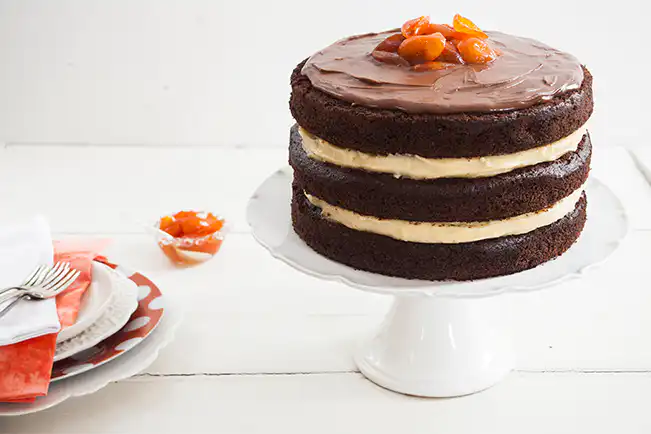
- Peel off the butterpaper still wrapped around the cakes. Have ready all the items required for assembly: the three cake layers, sugar syrup, frosting cream, ganache, and orange jam. If the frosting cream is too stiff, briefly mix it to smooth it out.
- Position the removable background of one of the fumes on a grid and rest the disk on top. Trim the top with a pastry knife (or a long bread knife) to make it even. Use the fume background as a base to move the disk to the cake plate. Lightly brush the sugar syrup over the dough without saturating it, which will prevent it from breaking. Have you noticed that we’re using the removable background like a cake lifter?
- Put half of the cream in the middle of the cake. Using a spatula or the back of a spoon, evenly spread a smooth layer, leaving about 1 cm from the edges without letting the cream spill over the sides. Keep in mind that the weight of the cake layers will compress the cream.
- For the next cake layer, follow the same steps used on the grid, then place the disk on top of the cream covering the first cake. Apply more syrup with a brush and spread the remaining cream over it.
- For the final cake, follow the same steps until placing the disk on top. Use a confectioner’s spatula to spread the chocolate ganache, garnish with kumquat compote, and serve immediately.